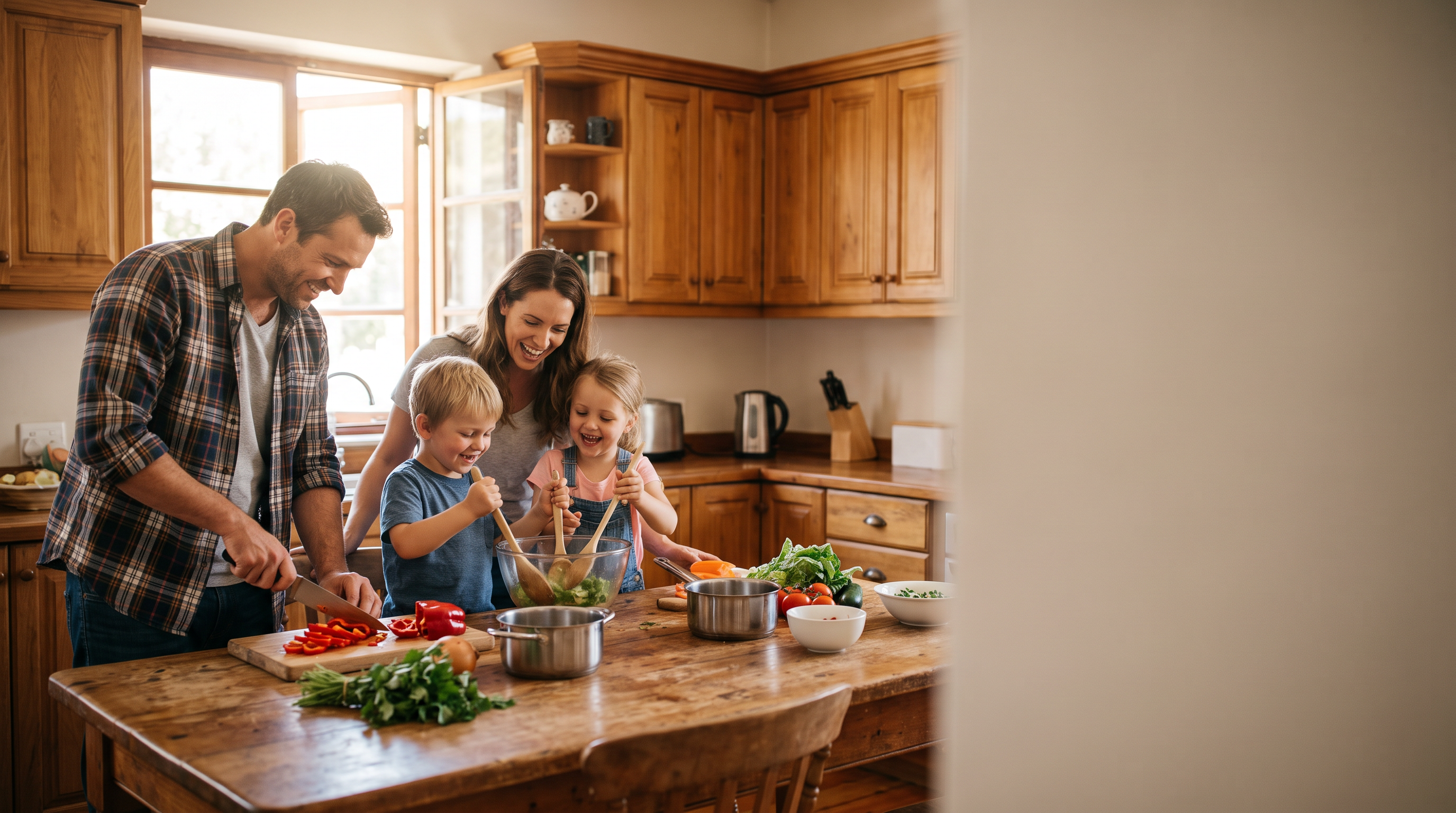
Struggling with dinner time? Discover why the 30-minute mark is key and explore easy family dinner recipes to simplify your routine and avoid the takeout trap.
Why the 30-Minute Mark is the Gold Standard for Family Dinners
The 30-minute threshold is not arbitrary — it is the point at which easy family dinner recipes remain realistic, and the pull of takeout becomes resistible.
According to The Kitchn, 43% of home cooks define a "quick and easy" recipe as one that takes 30 minutes or less to prepare. That single data point reveals something important: speed is a necessity. For most families navigating work schedules, homework, and the general chaos of a weeknight, it is the deciding factor between cooking and ordering out.
Home cooking habits have shifted considerably in recent years. Allrecipes reports that 74% of home cooks are trying more new recipes than they did two years ago — a signal that people are actively searching for better, faster solutions rather than falling back on the same rotation of meals. But ambition without efficiency tends to collapse under pressure. When a recipe runs long, the motivation to cook tomorrow night drops with it.
The 30-minute mark works as a psychological anchor. Once a meal stretches past that window, the perceived effort tips the mental scales toward convenience food. What follows in this article is built around staying comfortably inside that boundary — starting with a framework that makes high-flavor dinners feel far less like cooking and far more like assembling.
The 'Lazy Dinner' Framework: High Flavor with Low Effort
The most effective easy dinner ideas for family nights are not the ones that require the least skill — they are the ones designed to eliminate unnecessary steps without sacrificing the result.
That reframe matters. "Lazy" has picked up an unfair reputation in the kitchen, implying corner-cutting or nutritional compromise. In practice, choosing efficiency over effort is simply smart planning. A dinner that takes 20 minutes and satisfies everyone at the table is not a lesser meal. It is a better-engineered one.
The clearest way to apply this thinking is to separate two distinct categories:
- Assembly meals — components are prepared or purchased ready-to-use, and dinner happens through combination rather than cooking. Black bean tacos built from canned beans, pre-shredded cabbage, and store-bought salsa are a textbook example. There is almost no active cook time, yet the flavor profile is complete.
- One-pot meals — everything goes into a single vessel, reducing both hands-on time and cleanup. A chickpea and tomato stew made from pantry staples can be on the table in under 25 minutes with minimal chopping required.
- Sheet-pan meals — sheet-pan gnocchi tossed with cherry tomatoes, olive oil, and Italian seasoning roasts in one layer while you handle everything else. The oven does the heavy lifting.
Pre-prepped ingredients are the engine behind all three categories. Using frozen riced cauliflower, canned legumes, rotisserie chicken, and jarred sauces eliminates the chopping phase — and research confirms that integrating ingredient information directly into recipe steps reduces cognitive load for home cooks, making the whole process feel more manageable on a Tuesday evening.
That same logic applies to the families most likely to benefit here: those with younger children who have specific preferences and limited patience. The assembly-meal model, in particular, offers a solution worth exploring — dinners that let kids feel in control without turning you into a short-order cook.
Kid-Friendly Favorites That Don't Require Short-Order Cooking
The single most effective solution to picky-eater gridlock is designing meals with built-in flexibility — not cooking separate dishes for every family member.
Simple dinner ideas for family nights work best when they give children a sense of control without creating extra work for the cook. The most practical approach here is the deconstructed meal: a taco bar, a build-your-own pasta bowl, or a sheet pan spread where kids assemble their own plates from a shared set of ingredients. Everyone eats the same core components, but the experience feels personalized.
Familiar anchor foods tend to work better than forcing an entirely new dish. Mild pasta bakes and simple chicken tenders are reliable staples for a reason — they provide a "safe" foundation that reduces mealtime resistance. Research on family meal patterns consistently shows that repeated, low-pressure exposure to new flavors alongside familiar ones is more effective at broadening children's palates than presenting unfamiliar dishes in isolation.
The four recipe archetypes that tend to satisfy both kids and adults without extra labor are:
- Deconstructed tacos or burrito bowls — shared proteins and toppings, fully customizable
- Mild pasta bakes — hidden vegetables, familiar textures, one-dish cleanup
- Sheet pan chicken with roasted sides — hands-off cooking, easy to portion separately
- One-pot soups or stews — vegetables blended or softened into broth for texture-sensitive eaters
Research confirms that providing a structural overview with sub-goals helps cooks plan and perform tasks in parallel — a principle that applies directly to deconstructed meals, where you can prep components simultaneously rather than sequentially.
And that parallel-task thinking becomes even more important when the clock is really tight — which is where the 20-minute weeknight sprint comes in.
Mastering the 20-Minute Sprint for Busy Weeknights
For a meaningful slice of home cooks, even 30 minutes is too long — quick family dinner recipes must be ready in 20 minutes or less, or the whole routine falls apart.
According to The Kitchn's 2024 home cooking survey, an additional 24% of home cooks cap their ideal cooking time at just 20 minutes. That is not a niche preference — it is a significant portion of families who need a fundamentally different approach to weeknight cooking. The solution is not simpler recipes. It is smarter ingredient selection paired with a disciplined execution workflow.
Speed-demon ingredients are the backbone of any 20-minute meal. These are foods that require minimal transformation before they hit the plate:
- Couscous — absorbs boiling water in five minutes flat, requiring no active stovetop attention
- Shrimp — cooks fully in two to three minutes over high heat, making it one of the fastest proteins available
- Canned beans — already cooked, already seasoned, and packed with protein and fiber
- Pre-cooked rotisserie chicken — pull, shred, and serve; the hard work was done at the store
High-heat cooking methods, particularly stir-frying, are the natural partner to these ingredients. A screaming-hot pan condenses what might otherwise be a 40-minute meal into a focused, fast sequence. The rapid caramelization also adds depth of flavor that slower methods take far longer to develop.
The 3-step rapid workflow that ties this together is straightforward:
- Prep everything before the burner turns on. Measure, chop, open cans, and shred chicken while water heats. The moment cooking starts, execution should be uninterrupted.
- Cook protein and aromatics simultaneously on high heat. Shrimp and garlic in a hot pan, for example, are done together in under four minutes.
- Finish with a pre-made sauce or seasoned liquid. A splash of soy sauce, broth, or canned tomatoes brings the dish together without adding time.
This kind of speed-focused structure naturally raises a question many families face alongside the clock: what does a fast dinner actually cost? That tension between speed, quality, and budget is where the next layer of the solution lives.
Budget-Friendly Dinners That Don't Skimp on Nutrition
Eating well as a family does not have to mean choosing between your grocery budget and your household's health — the right ingredients do both jobs at once.
Bulk buying is one of the highest-return habits a home cook can build. Dried lentils, brown rice, chickpeas, and black beans typically cost less than $2 per pound, yet each pound yields multiple servings packed with protein and fiber. The return on investment compounds when you factor in versatility: a single batch of cooked lentils can anchor a weeknight stew, fill a wrap the next day, and bulk out a soup by Friday. That kind of stretch ingredient turns one grocery purchase into three meals — a far cry from the processed convenience foods that cost more per serving and deliver far less nutritionally. And research consistently shows that regular family meals are associated with improved fruit and vegetable intake and better overall nutritional status, making the investment in whole-food staples worthwhile beyond just the dollar savings.
What often gets overlooked is how well slow-cooker staples serve this dual goal. Pulled pork shoulder, lentil stews, and bean-based chilis are the original lazy dinner for family households — minimal prep, long unattended cook times, and enough volume to feed everyone twice. These meals rely on inexpensive cuts and pantry staples rather than premium ingredients, yet they consistently outperform processed alternatives on both cost and nutrition.
| Ingredient | Avg. Cost per Serving | Key Nutritional Benefit |
|---|---|---|
| Dried lentils | ~$0.30 | High protein, high fiber |
| Brown rice | ~$0.20 | Complex carbs, manganese |
| Canned chickpeas | ~$0.40 | Plant protein, iron |
The patterns covered in this section — bulk staples, stretch meals, slow-cooker methods — all point toward a broader system. The next section distills those patterns into a practical cheat sheet you can apply any night of the week.
What You Need to Know: The Easy Dinner Cheat Sheet
The fastest way to fix a broken dinner routine is not finding more recipes — it is building a repeatable system around a small set of proven strategies.
Every section of this article has pointed toward the same underlying truth: structure reduces stress. Whether you are working with a 20-minute window or a tight grocery budget, the cooks who consistently get dinner on the table tend to rely on a short list of non-negotiables. Here is what that list looks like in practice.
Time boundaries matter more than most home cooks realize. Prioritizing recipes with a 30-minute total time — not just active cook time — creates a realistic ceiling that holds up even on difficult evenings. Sources like 70 Easy Dinner Ideas organize meals around exactly this kind of constraint, making it easier to browse with confidence.
Structural meal templates do the heavy thinking for you. Sheet-pan dinners, grain bowls, and stir-fry formats are not just convenient — they reduce the cognitive load of deciding how to cook, so your energy goes toward feeding people rather than problem-solving.
- Lazy pantry staples — canned beans, pasta, tinned tomatoes, frozen vegetables, and broth — cover emergency nights without a grocery run.
- Parallel tasking starts before you turn on the stove. Reading the full recipe overview first lets you overlap steps and cut real time.
- One-pot or one-pan formats eliminate the cleanup burden that makes weeknight cooking feel not worth the effort.
Building these habits consistently is what transforms dinner from a nightly scramble into something you can actually look forward to — which is exactly why curating your own go-to recipe library is the logical next step.
Building Your Personal Recipe Library for Long-Term Success
The shift from dinner-time stress to a reliable strategy comes down to one decision: choosing a small set of recipes you trust and returning to them consistently.
The previous sections mapped out the obstacles — decision fatigue, unrealistic planning, tight budgets — and offered practical frameworks to move past each one. What ties all of that together is the idea of ownership. A personal recipe library is not a folder stuffed with aspirational meals you will never cook. It is a short, living list of meals your family actually eats, built up gradually and refined over time.
Starting small is the most effective approach. This week, commit to bookmarking just three go-to recipes: one that takes under 30 minutes, one that stretches a budget protein, and one that the whole household reliably finishes. According to research on family meal patterns, consistent shared meals are linked to measurable improvements in family cohesion and nutritional outcomes — but that consistency only becomes possible when the recipes themselves feel manageable. Three solid anchors build more momentum than a saved collection of thirty meals you have never attempted.
Recipe discovery becomes far less overwhelming when you have a trusted destination. Recipes-cookingfood.com is structured around exactly this need — accessible, step-by-step tutorials organized by meal type, time commitment, and skill level, so you are never sorting through irrelevant results to find something practical. And because the library covers everything from five-ingredient weeknight dinners to budget-conscious batch cooking, it grows with your household's needs rather than replacing them.
Explore the Recipes-cookingfood.com blog categories to find your next three anchor meals and take the first concrete step toward a dinner routine that actually works — for your schedule, your budget, and your family.
Comments
Post a Comment